
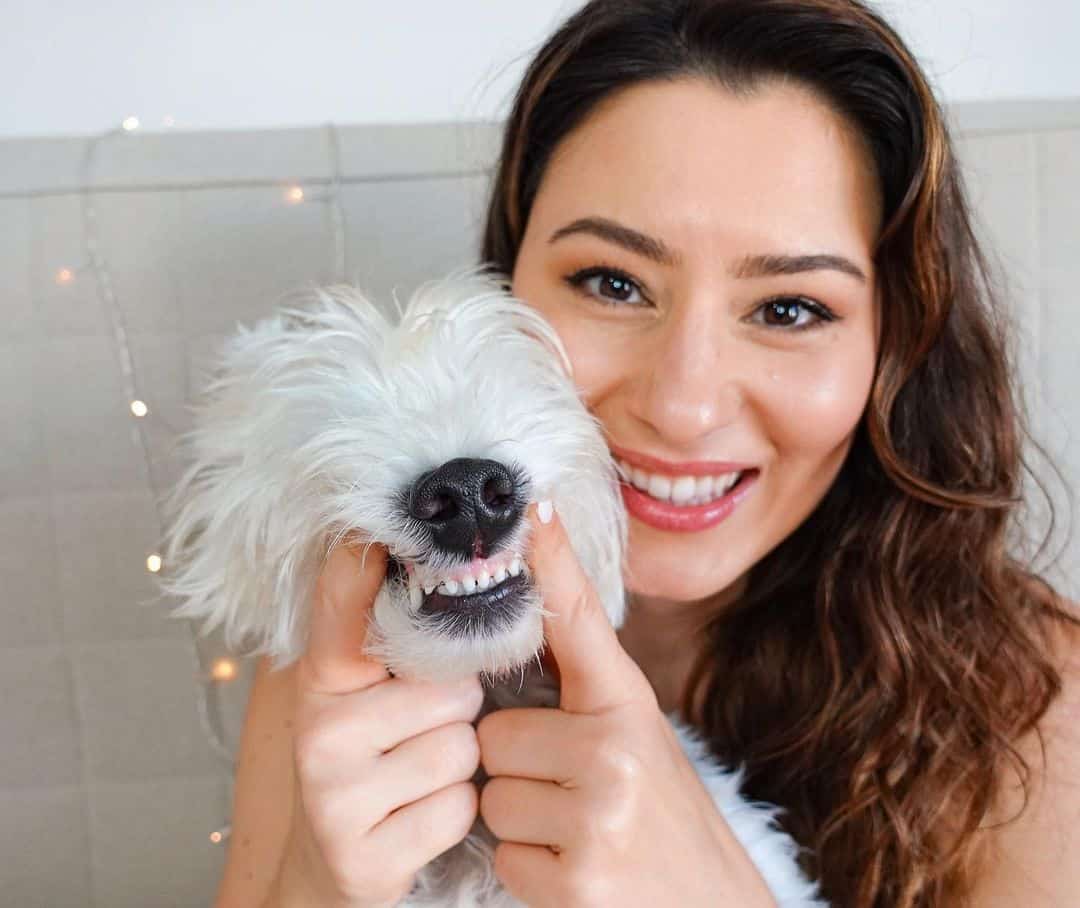
Sami greets us every morning the same way - he stretches, blinks, and then shows us his canines. Both of them. It looks unmistakably like a smile, and it took me embarrassingly long to realise that this is, more or less, his version of laughing.
It's a question I get a lot from people who've watched him on Instagram. Do dogs actually laugh? Or are we projecting? It turns out the science is more interesting than I expected.
Do dogs actually laugh?
Yes - though "laugh" is a stretch and "vocalised play-pant" is closer to the truth.
Researchers who've studied canine vocalisations identify a distinct sound dogs make during play, often described as a breathy hhuh-hhah. It's not a bark. It's not a growl. It's a forceful, rhythmic panting that sounds, to a human ear, a lot like laughter. The most-cited work on this comes from animal behaviourist Patricia Simonet, whose 2001 research recorded the sound at dog parks and found that playing it back to other dogs reliably triggered play behaviour in them. In other words: it's not just a noise, it's a social signal. Dogs use it to invite other dogs (and us) to keep playing.
Sami's version is quieter than the textbook description. He does it when we're playing tug, when he's chasing his orbee ball, when one of us comes home after being out longer than he thinks is acceptable. It's not the smile - that's a separate behaviour - but it lives in the same emotional neighbourhood.
Do dogs have a sense of humour?
Loosely, yes. Probably not the same way we do.
One thing that gives dogs something humour-adjacent is neoteny - dogs have been bred over thousands of years to retain juvenile traits into adulthood. Puppies play. Wolves mostly stop playing as adults. Domestic dogs don't, and that retained playfulness is part of what makes them such good companions. A Westie's whole personality leans heavily on this - Sami is six and still acts, on a good day, like a puppy.
Charles Darwin actually wrote about this, observing that dogs seemed to engage in deliberate teasing and playful trickery. Modern research has backed this up to a point - dogs do seem to find specific situations funnier than others. Hiding behaviours, the bait-and-snatch with a toy, the deliberate "I'm going to pretend I don't have your sock" moment - these aren't random.
Do dogs understand our laughter?
This one is well-supported. Dogs are extremely good at reading human emotional cues - probably better than any other domesticated animal. They can distinguish a smile from a neutral face, a laugh from a shout, our happy voice from our annoyed voice. Westies are particularly tuned in to their people, which means Sami absolutely knows when I'm laughing, and it visibly changes his behaviour. He gets bouncier. He tries to be part of whatever is happening.
What dogs probably don't do is "get the joke" in the linguistic sense. But they read the room. Our happiness genuinely lifts theirs.
Does your dog try to make you laugh?
Probably, yes - though it's hard to prove they're doing it on purpose.
Here's what I've observed with Sami. When he does something we react to with laughter - a particular zoomie pattern, a specific dramatic flop onto the floor, the way he stares at us when he disapproves of something - he tends to do it again. And again. Whether that's intentional comedy or operant conditioning (we laugh, he gets attention, he repeats the behaviour) is genuinely hard to separate. But the effect is the same. He learns what we find funny and he leans into it.
Some of our daily routines have evolved this way. He developed a face-rubbing thing on the carpet that we found hilarious; he now does it nearly every morning. Cause and effect or coincidence? I'd guess somewhere in between.
How to play with your Westie so they "laugh"
If you want to hear the play-pant from your own dog, it shows up most reliably during:
- Active games where you're a participant. Tug, chase, hide-and-seek with treats or toys.
- Surprise play. The play-bow gesture (front down, back up) often precedes the sound.
- Reunion moments. Coming home after a few hours out is often when it's clearest.
- Specific high-value toys. Sami's orbee ball produces it more reliably than any other toy in the house.
What you won't get it from: structured training sessions, walks where they're focused on sniffing, or environments where the dog is overstimulated. The play-pant is a relaxed-but-engaged sound, not an excited-and-overstimulated one.
Frequently asked questions
Is the "dog smile" the same as laughing?
Not quite. The bared-teeth "smile" you see when your dog greets you is usually a submissive or affectionate gesture, not a vocalisation. The laugh equivalent is the breathy play-pant, which is a sound rather than a facial expression. Some dogs do both; Sami does.
Can dogs tell when you're sad?
Yes, very reliably. Multiple studies have shown dogs respond differently to crying than to laughing or neutral sounds, and they tend to approach distressed humans even when they don't know them.
Why does my Westie pant during play?
It's almost certainly the play-pant - a social signal inviting more interaction. As long as it's not accompanied by signs of overheating (excessive drooling, lethargy, very heavy breathing), it's a positive thing and means your dog is having fun.
About Westie Vibes
Westie Vibes is the home of Sami the West Highland White Terrier — tips, stories, and everything we’ve learned about life with a Westie.
Follow along and subscribe for weekly updates.