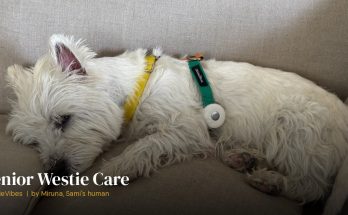
If your westie occasionally skips on a back leg, holds one leg up for a few steps, and then walks normally again, that’s most likely luxating patella – the kneecap slipping out of its normal groove. It’s one of the more common orthopedic issues in small breeds, and westies are among the predisposed.
What It Looks Like
The classic sign is intermittent skipping. Your westie is walking normally, then suddenly lifts a back leg for a step or two, or does a little hop-skip. A second later they’re walking fine again. In mild cases, this happens occasionally. In more severe cases, it becomes frequent and the leg may lock in a bent position temporarily.
This is exactly what happened with Sami. He started skipping on his back leg – first every few steps, then almost every step. It began when we were in Greece, after we’d gone from daily walks on soft forest ground to walking in the marina on hard streets and concrete.
Getting a Diagnosis
We took Sami to the vet and did X-rays. The results didn’t show anything obviously wrong structurally. The vet’s assessment was nerve sensitivity and possibly early joint changes, not a classic luxating patella case – which shows that the leg skip doesn’t always have a straightforward explanation.
Your vet will physically examine the knee, checking if the kneecap can be manually displaced from its groove. Luxating patella is graded 1-4:
Grade 1: The kneecap can be manually moved out of position but returns on its own. Your westie may occasionally skip but is mostly normal.
Grade 2: The kneecap spontaneously luxates (slips out) during movement and sometimes stays out until manually repositioned or until the leg is extended.
Grade 3: The kneecap is out of position most of the time but can be manually put back.
Grade 4: The kneecap is permanently displaced and cannot be repositioned. This usually requires surgery.
Grades 1-2 are managed conservatively in most cases. Grades 3-4 often need surgical correction.
What Helped Sami
Mobility supplements. We started him on joint support supplements containing glucosamine and chondroitin. These won’t fix a structural problem, but they support joint health and may slow progression.
Daily physiotherapy exercises. I do about 10 reps each morning – gentle leg stretches and range-of-motion exercises. The vet showed me the specific movements. It takes about 5 minutes and it’s become part of our morning routine.
Dog steps. I got steps so Sami can get on and off the bed and couch without jumping. Jumping puts significant stress on the knee joint, and I should have done this years ago regardless of the leg issue.
Dog boots on hard surfaces. This was the unexpected discovery. When Sami wears his boots, the skipping almost completely stops. The vet thinks the rubber soles absorb some of the impact from hard ground that was aggravating the problem. It’s not a universal solution, but it’s worth trying.
Prevention and Weight Management
Keeping your westie at a healthy weight is the most important preventive measure for joint problems. A healthy adult westie is 7-10 kg (15-22 lbs). Every extra kilogram puts additional stress on the knee joints. See our westie weight guide for details.
Exercise on varied surfaces – not just hard pavement. Grass, dirt paths, and softer ground reduce the repetitive impact on joints. Avoid letting your westie jump from heights repeatedly, especially off furniture. Ramps or steps for beds and couches are a small investment that protects joints long-term.
For the full health screening schedule and other breed-specific conditions, see our westie health problems overview.
Watch: Sami’s Story
More on Sami’s health journey, including his leg and paw issues: