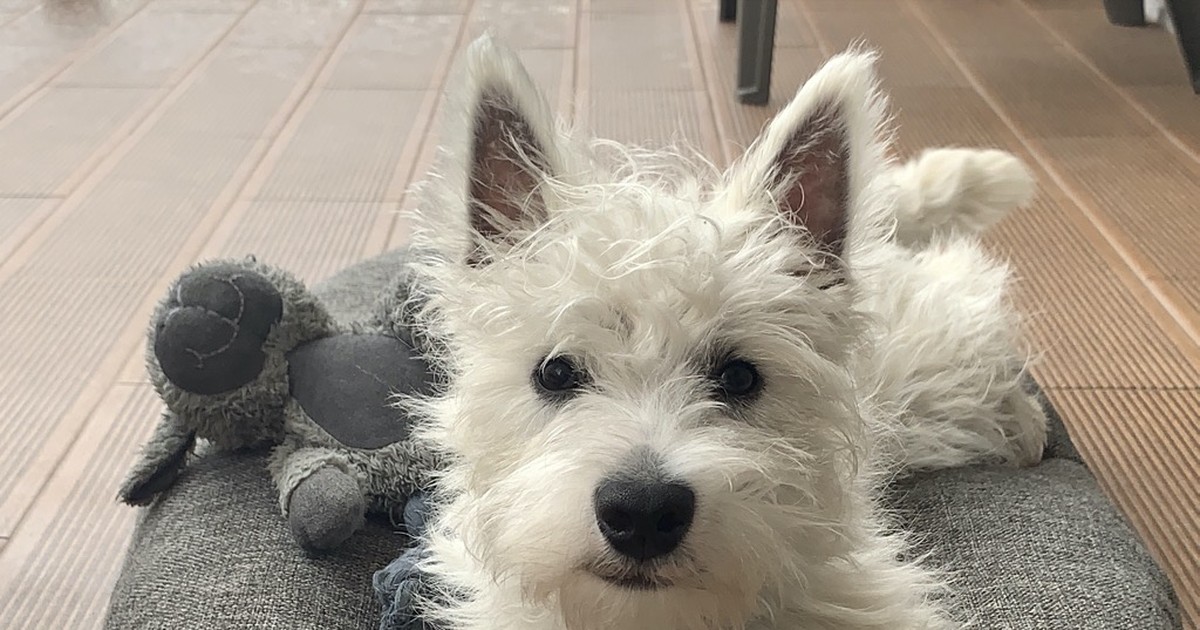
If you’ve ever called your westie and watched them look right at you and then go back to whatever they were doing, you already know what I’m about to say. Westies are terriers. They were bred to hunt rats and foxes underground, alone, making independent decisions without human direction. That breeding is the root of everything about their personality.
A westie that ignores your recall command is not stupid. They heard you perfectly. They’re making a calculation about whether coming back is more interesting than what they’re investigating. Your job is to make the right choice consistently more rewarding than the wrong one.
The Core Personality Traits
Independent and Confident
Westies have more self-assurance per kilogram than any breed I know. Sami walks into a room like he owns it, regardless of what room it is. He’s been in airports, on boats, in restaurants across Europe, and his confidence level is exactly the same everywhere. This confidence is charming, but it’s also why traditional obedience training often fails – a westie doesn’t feel a natural need to please you the way a golden retriever does.
Stubborn (or: Selective About Cooperation)
The so-called “westitude” is not a myth. Sami can be extremely stubborn at any given moment. Sometimes he refuses to walk in a direction, and no matter what I do, he holds his ground while bravely maintaining eye contact. He’s not confused. He just disagrees.
Dealing with westitude is possible. It just takes training and, honestly, some negotiating. If Sami isn’t in the mood for a walk, I’ll say “let’s go out and see the dogs.” He immediately perks up because the possibility of seeing other dogs is enough motivation. This trick never fails, even when we don’t actually meet any other dogs.
Another one: I open the door and pretend to say hi to an imaginary someone. He always comes running to see who I’m talking to.
Intensely Curious
Sami needs to know everything. And I mean everything. No jar can get opened, no bag can crinkle, no door can open or close without his nose coming around to investigate. We joke that he’s like the nosy neighbor who spends their time looking through the peephole, concerned with what everybody is doing.
This curiosity is actually useful. It’s what makes puzzle feeders and interactive toys so effective. When he’s working to get treats out of a toy, he’s fully engaged and it tires him out as much as a walk.
Alert and Vocal
Westies bark. This is non-negotiable breed behavior. They were bred as alert dogs – their job was to announce anything unusual. A westie that barks at the doorbell, at dogs walking past the window, and at suspicious noises is doing exactly what generations of breeding programmed them to do.
You can manage the barking (more on that in our barking guide), but you won’t eliminate it. Accept this before getting a westie.
Affectionate on Their Terms
Westies aren’t lap dogs in the constant-cuddling sense. They’re loyal and want to be near you, but they have opinions about when and how affection happens. Sami will decide when it’s cuddle time, and it’s usually not when I decide it is. When he does want attention, he’s incredibly warm. The rest of the time, he’s content being in the same room doing his own thing.
What Westies Need From Their Owners
45-60 minutes of daily activity, split across two or three sessions. This is a medium-energy breed – not hyperactive, but definitely not a lap dog. Two 20-minute walks plus a play session covers it for most adult westies.
Mental stimulation. A bored westie is a destructive westie. Puzzle feeders, sniff walks, training games, and rotating toys keep their brain occupied. Mental exercise tires them as effectively as physical exercise.
Consistent boundaries with positive reinforcement. Punishment doesn’t work with terriers – they dig in and resist harder. Positive reinforcement with high-value treats and short training sessions (5-10 minutes maximum) is the only approach that produces lasting results. See our westie training guide.
A secure outdoor space. Westies have a powerful prey drive. A squirrel, cat, or blowing leaf can trigger a chase response that overrides every command you’ve ever taught. I don’t trust Sami off leash almost anywhere, no matter how well trained he is. He’s always leashed or in a securely fenced area.
Are Westies Good for First-Time Dog Owners?
They can be, if you know what you’re getting into. The westie temperament rewards patience, consistency, and a sense of humor. If you want a dog that hangs on your every word and lives to please you, a westie will frustrate you. If you want a dog with genuine personality, independence, and a talent for making you laugh, a westie is hard to beat.
They’re not the easiest breed to train. They’re not the most obedient. But they’re endlessly entertaining, fiercely loyal in their own way, and once you’ve lived with one, it’s hard to imagine life without a westie in it.
For training strategies that work with the westie brain, see our westie training guide. For the full care picture including grooming, health, and nutrition, the Complete Westie Care Guide covers everything.
Watch: Sami’s Story
We did a whole podcast episode on why westies are not like other dogs:
Sami mumbling when he wants something – classic westitude: