
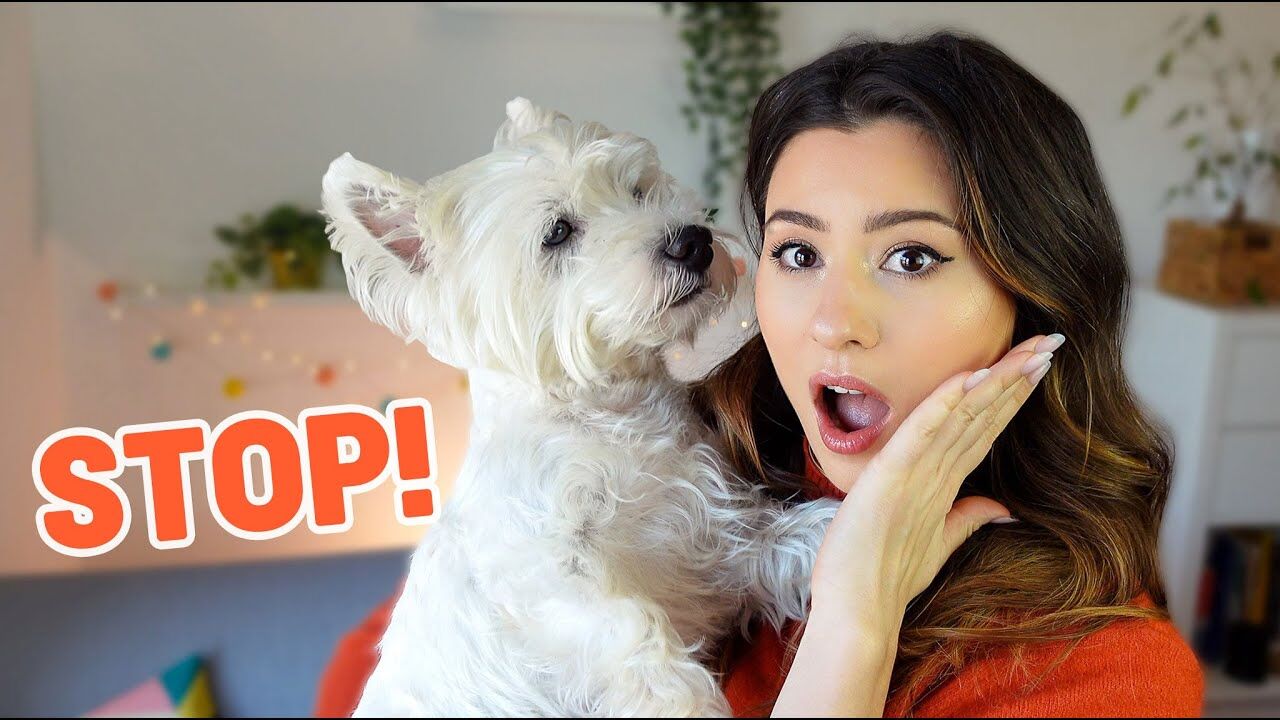
Westies are not dramatic dogs. Sami rarely barks, almost never whines, and hides discomfort like it's a professional obligation - which means that for the first couple of years, I regularly missed the moments when he was stressed or annoyed. Over time I learned to read five specific signals, and they changed how I understand him. Here they are, with exactly how they look on a real Westie.
1. Tongue Smacking and Lip Licking
Quick little lip licks and tongue smacks, with no food anywhere in sight. This took me embarrassingly long to decode. Dogs do it to self-soothe when they're uncomfortable - and once you know, you see it everywhere.
Sami's version: he wakes up at 5 am and starts licking himself, we groan "Sami, stop it," he obeys - and immediately starts smacking his tongue in protest. He also does it near smells he hates (bananas, lemons, onions) and the instant he realizes the "treat" in my hand is actually a pill, usually while walking backwards.
2. The Side-Eye
Officially it's called whale eye: the head stays still, the eyes slide sideways, and you can see the whites. Unofficially, it's the look Sami gives me when I find him being adorable somewhere and decide to invade his space with kisses he did not order.
Sometimes he welcomes the affection - ears back, tail wag, lovely. Other times: the flat sideways look. If I persist, he turns his head fully away, possibly under the theory that if he can't see me, I stop existing. Either way, the message is clear. One quick kiss and I retreat with my dignity partly intact. Respecting that boundary matters - it's how he learns that his no is heard, which is exactly what keeps a dog from ever needing a louder no.
3. Yawning (the Fake Kind)
A yawn out of context - when nobody's sleepy - is a dog's eye roll. Sami deploys it when the neighbor's dog is barking and I won't let him go answer, or when he petitions for a midday walk and gets declined. Things don't go his way, out comes the yawn.
How do you tell a stress yawn from a real one? My own field discovery, offered without scientific warranty: the tongue. Sami's genuine sleepy yawn comes with a fully curled tongue; the stress yawn has no curl at all. I've tested this for years and it hasn't failed me yet. Check your own dog and report back.
4. The Shake-Off
Dogs shake when wet, obviously. But a full-body shake on a dry dog, right after a tense moment, is a reset button - shaking off the built-up stress, literally.
Sami does two or three in a row after we pass a dog that got him worked up (he may not look it, but he can be a hot head - his history with other dogs explains why). Also immediately after the harness or raincoat comes off, which tells you exactly what he thinks of the harness and the raincoat.
5. Sudden Scratching or Self-Biting
Mid-interaction, out of nowhere, the dog spins around to urgently scratch or chew a spot that was fine two seconds ago. That's displacement - the canine version of nail-biting. A well-adjusted dog who's reached "that's it, I've had enough" doesn't snap at you; they redirect onto themselves.
Sami's triggers: a dog who wants to play when he doesn't, a kid pulling his tail (true story, sadly), or me holding a treat while over-explaining a trick he doesn't understand. Frustration builds, and suddenly his leg desperately needs chewing. That's my cue that the interaction is over - I either remove him from the situation or ask for something easy he knows, reward it, and let him win his way out.
Why Westies Are Extra Hard to Read
These signals matter more with this breed than most. Westies are famously stoic - Sami once ripped a nail off completely without making a single sound, and an ear infection had to reach real pain before he showed anything at all. A labrador tells you about their feelings constantly and at volume. A Westie files their distress quietly, in the small print, and expects you to have read it.
The situations where I most often catch the signals, if you want to know where to practice: grooming and baths (tongue smacking during the blow-dry is a classic), the vet's waiting room, being dressed in anything, crowded places with dogs at close range, guests who love dogs a bit too enthusiastically, and any training session that has gone on ninety seconds too long. Travel days too - the shake-off count on an airport day tells me exactly how Sami's coping.
What to Do When You Spot a Signal
Nothing complicated: change the situation. Take him away from the pushy dog or the grabby toddler. Stop the training session that's gone frustrating - ask for one easy trick, pay up, end on a win. Stop kissing the dog who has filed a formal complaint. The signals are your dog handling stress well, in their language; your half of the conversation is listening.
A useful rule of thumb I've settled on: one signal is a mood, a cluster is a message. A single yawn means little. A yawn plus lip smacking plus the side-eye, inside the same minute, means get your dog out of there now - that's a dog working hard to cope, and the polite options are running out. The escalation usually runs in that order too, from the small self-soothing gestures up to the sudden self-scratch, so the earlier you respond, the cheaper the fix.
The payoff compounds. A dog whose subtle signals get answered never needs to escalate to growling or worse, and they trust you more because you're apparently the one human who speaks dog. With an independent breed like this one, that trust is the whole relationship - the Westie temperament guide goes deeper on reading their affection on their terms.
When Stress Signals Mean a Vet Visit
One caution, because Westies hide pain expertly: if the signals suddenly spike in frequency for no situational reason - constant lip licking, repeated shake-offs at rest, obsessive self-chewing at one spot - stop reading it as mood and start suspecting the body. Pair it with appetite changes, restlessness, or withdrawal, and it's a vet visit, not a training question. Excessive licking of one area in particular can mean pain or skin trouble underneath. We're owners, not vets; when a behavior change has no story behind it, let the vet rule out the medical chapter first.
And if the stress signals cluster around being left alone, that's its own topic - see can Westies be left alone.
Filming the video version of this took a week off Sami's patience, so at least the demonstrations are authentic. The rest of what he's taught us - routines, training, the daily rhythm that keeps him relaxed - is in the Complete Westie Care Guide.

About Westie Vibes
Westie Vibes is the home of Sami the West Highland White Terrier — tips, stories, and everything we’ve learned about life with a Westie.
Follow along and subscribe for weekly updates.